


Category: History Date: 2026-09-01
Construction of Major Dam
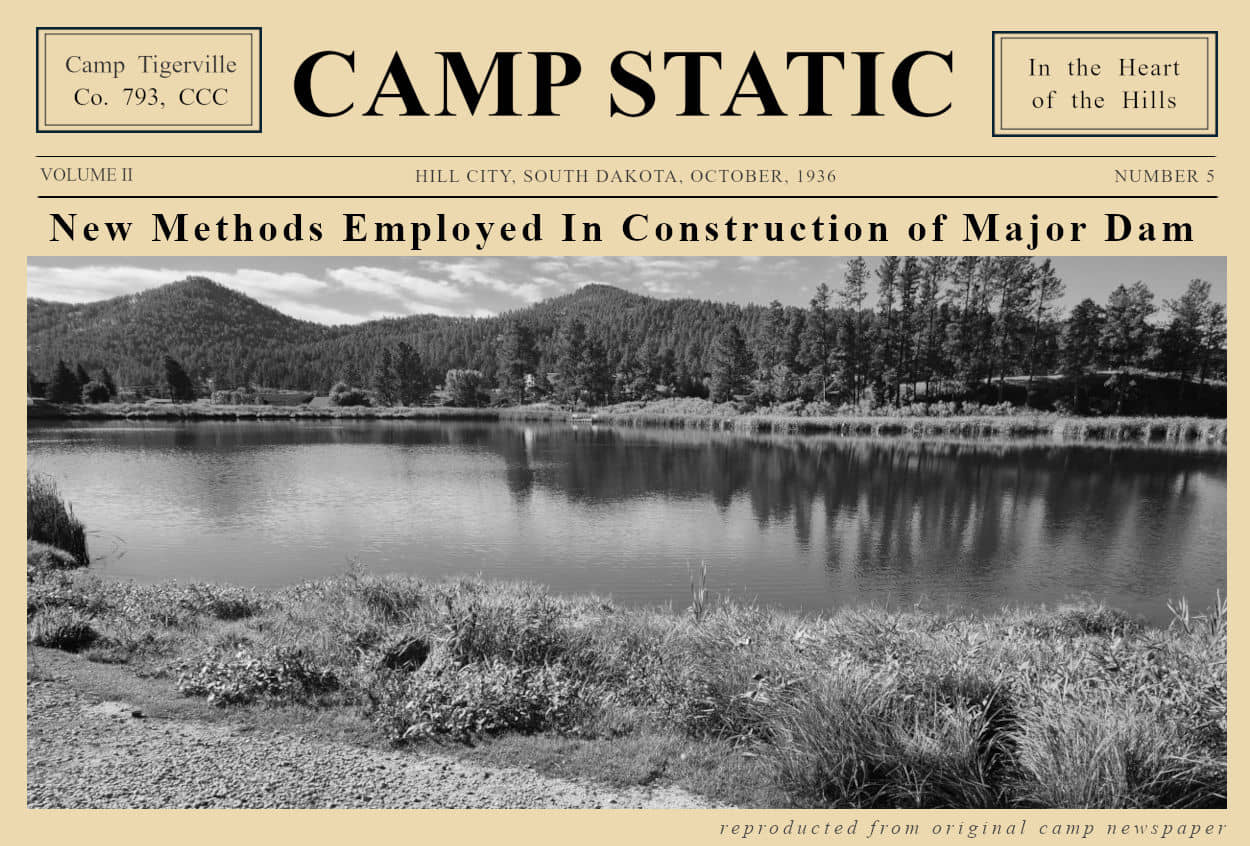
Camp Tigerville Works on One of Chief Projects in the Harney National Forest This Year
By Ed (White Bear) Rentz
One of the outstanding projects undergoing construction in the area of the Harney National Forest is the Major Dam. This project is situated north of U S. Highway 85 Alternate, a short distance east of Hill City. The work is under the supervision of the U.S. Forest Service, the labor is being performed by the members of Company 793, Camp F-15, CCC.
The machinery being used in the construction of this dam consists of all modern equipment and devices used in this particular type of construction, such as a cement mixer, two air compressors, a three-fourths yard Diesel shovel, a roller, compressor and air drills, a grouting machine, automatic earth tampers, cletracs, derrick pumps, a fleet of dump trucks consisting of eight units together with various hand tools and implements.
The dam was authorized and approved by Mr. Brownlee, Regional Engineer of the U. S. Forest Service at Denver, Colorado. When completed, this body of water will cover approximately eight acres and will be eight feet in depth at the overflow. The water- supply will be maintained by subterranean springs and by the headwaters of Newton Fork Creek.
The spillway is of reinforced concrete, five hundred eight yards of it being used in the completion of this project. More concrete is used in this one construction project than in any other dam under Forestry Supervision.
The excavation for the core of the dam is twenty feet in depth, the clay core being laid in solid rock and tamped by automatic tampers. Afterwards the trench is filled with additional clay and is then tamped and rolled to a compact mass to the height of the overflow. Upon the completion of the core and dam fill, the earth filling will be reinforced by rock and then rip-rapped.
In excavating the core trench, many obstacles were met, among them being the constant flow of water from springs and the quality of the rock encountered, which developed into strata of fissure-laid rock. Since the core had to be built on solid or bed rock, it was found necessary to excavate the core trench to a depth of twenty feet in order to overcome these fissures. The flow of water from springs encountered at this depth was a problem. In order to combat and eliminate this handicap, pumps were installed to keep the water at the lowest possible level. Compressed air drills were used to a depth of twenty feet from the bottom of the core trench or bed rock and then grout pipes were installed. Finally, bentonite mixed with water was forced through the fissure and subterranean water channels, thereby eliminating the outlet of the springs and overcoming the flow or intake of the water.
Bentonite, which is found in great quantities in the area north of Belle Fourche and whose composition is that of decomposed volcanic ash, is used, for the first time, in the history of constructional engineering in the manner stated. In all excavations of dams of deep nature, particularly in the Harney and Black Hills National Forests, the flow of water is a serious handicap, but since the discovery and use of bentonite as a grouting substance, this obstacle has at last been overcome. Scientifically speaking the discovery of bentonite, used as described, will undoubtedly eliminate the future problem of combating successfully the intake or flow of water in this class of construction.
Benefits of untold value will occur to the surrounding country upon the completion of this project. Not only as a beauty spot but as a conservation measure, should this dam be looked upon. The conservation of water is indeed a valuable asset to any country, and should be encouraged and accepted by those communities fortunate enough to have and to enjoy such projects. Major Dam will become one of the outstanding attractions, not only from the standpoint of recreation and beauty, but also from the viewpoint of increased value and protection to the surrounding area. The conservation of water, the attraction of wildlife, the improvement of scenic beauty, and the value to the community at large will indeed become an asset worthy of the expenditure.
Below is from "The Civilian Conservation Corps in South Dakota, 1933-1942" by Lyle A. Derscheid.
A report submitted in 1937 by Company 793 stated:
"Among its notable achievements was the building of the Major and Mitchell dams. The Major Dam was in the nature of a large laboratory project. Experiments were carried out with a bentonite grouting process being developed for the purpose of stopping dam leakage in earth dams. The process proved successful and the U. S. government had it patented. In the construction of the Mitchell Dam further experimentation was done with bentonite grouting."
Bentonite used for the first time in the history of constructional engineering.


